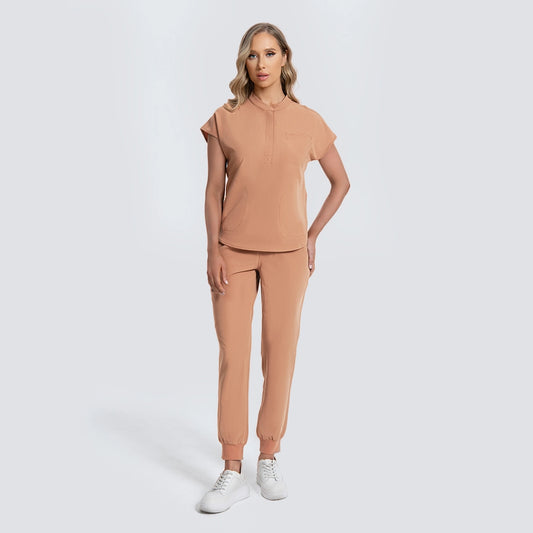
The word “premium” appears frequently in descriptions of medical uniforms, but a higher price or fashionable appearance does not automatically make a scrub set better. Truly premium medical scrubs should combine comfort, performance, thoughtful design and durability in ways that remain noticeable throughout a demanding shift.
A scrub set may look impressive when it is new, but its real quality becomes clearer after hours of bending, walking and carrying equipment—and after repeated washing. The fabric should recover instead of sagging, the waistband should remain secure, the pockets should be useful and the seams should withstand daily wear.
If you are comparing premium medical scrubs with basic alternatives, these seven details can help you decide whether the difference is meaningful.
1. Fabric That Feels Soft but Maintains Its Structure
Fabric is one of the clearest indicators of scrub quality. Premium fabric should feel comfortable against the skin while maintaining enough structure to create a clean, professional silhouette.
Material that is extremely thin may feel light, but it can lose shape, show wrinkles easily or provide insufficient coverage. Heavy fabric may feel durable but become uncomfortable in warm or highly active environments. The best option usually balances weight, softness, breathability and strength.
Pay attention to the fabric surface. A smooth, matte finish generally looks more refined than an overly shiny material. A dense, fine weave can also make colors appear richer and help the garment hang more evenly.
Premium does not necessarily mean delicate. Medical workwear needs fabric that can tolerate frequent movement and laundering. The material should feel pleasant without becoming fragile, transparent or excessively prone to snagging.
2. Stretch With Reliable Shape Recovery
Stretch can make scrubs easier to wear, but stretch alone is not enough. The fabric should also return to its original shape after being pulled or compressed.

Four-way-stretch material moves horizontally and vertically, making it useful for reaching, bending and taking long steps. However, low-quality stretch fabric may become loose around the elbows, knees or seat after several hours.
To test recovery, gently stretch part of the fabric and release it. It should return smoothly instead of remaining wavy or distorted. When trying on scrubs, sit, squat and raise your arms. The uniform should move naturally and recover once you return to a standing position.
Premium medical scrubs use stretch to improve mobility while preserving a polished appearance. The goal is not to make the uniform feel like tight athletic clothing but to allow the wearer to move without resistance.
3. A Fit Designed for Real Movement
A premium fit is neither excessively loose nor unnecessarily tight. It should follow the body while providing additional room in the areas that move most.
On a scrub top, shoulder seams should sit close to the natural shoulder line. The chest and back should allow comfortable reaching without creating large amounts of excess fabric. Side vents, curved seams and shaped panels can improve mobility while maintaining a clean silhouette.

Scrub pants should provide sufficient room through the hips, seat and thighs. A gusseted crotch or articulated knee can increase freedom of movement without requiring the entire leg to be oversized.
The rise, inseam and pant shape also affect the fit. Straight-leg pants should fall neatly over work shoes, while jogger cuffs should remain comfortably around the ankle. Petite, regular and tall lengths help preserve the intended proportions.
A stylish fit has limited value if it becomes restrictive during work. Premium scrubs should be evaluated while walking, bending, sitting and carrying normal pocket items.
4. Strong, Consistent Construction
Small construction details often reveal more about quality than decorative features.
Inspect the stitching around pocket corners, side seams, armholes, waistbands and the crotch. The stitches should be straight, evenly spaced and free from loose threads. High-stress points may include reinforced stitching or bar tacks to reduce the risk of tearing.
Interior construction matters as well. Neatly finished seams can reduce friction and help prevent fraying after repeated laundering. A well-constructed neckline should remain flat instead of curling, stretching or gaping.
Zippers, snaps and drawcord ends should feel smooth and secure. Hardware does not need to be large or highly visible to feel premium. Low-profile components with a matte finish often look more refined and are less likely to interfere with movement.
Quality construction should make the uniform feel dependable rather than complicated.
5. Pockets That Support the Workday
Pocket count is often used as a selling point, but more pockets do not necessarily create a better scrub set. Premium pocket design focuses on placement, access and weight distribution.
Hand pockets should be deep enough to hold small items securely. Cargo pockets should sit high enough that they do not swing against the knee while walking. Chest pockets should remain flat and should not pull the scrub top forward when lightly loaded.

Internal phone sleeves, pen slots and hidden zip compartments can improve organization without adding unnecessary bulk. Reinforced corners and durable pocket bags help the pockets tolerate frequent use.
Try loading the pockets with the items you normally carry. The waistband should remain stable, the garment should not twist and frequently used items should be easy to reach.
A premium pocket is not simply attractive when empty. It should remain comfortable and functional during a real shift.
6. Breathability and Practical Temperature Control
Healthcare professionals often move between warm patient rooms, cool workstations and busy corridors. Premium medical scrubs should help the wearer manage these changes.
Breathable fabric allows heat and moisture to move away more effectively than dense, poorly ventilated material. Moisture-wicking and quick-drying properties may help the uniform feel more comfortable during active work.
This does not mean that the lightest fabric is always the best. Very thin material may lose structure or coverage. Good performance fabric provides airflow while remaining substantial enough for daily professional wear.
Scrub design can also influence temperature. Side vents increase movement and airflow, while a neckline that sits correctly can feel more comfortable than one that is too high or too loose. A coordinated lightweight scrub jacket can provide extra warmth in cooler environments.
Premium performance is about maintaining comfort across changing conditions, not simply adding more technical claims to a product description.
7. Durability Through Repeated Washing and Wear
The real value of premium scrubs becomes clear over time.
Healthcare uniforms are washed more frequently than most everyday clothing. A quality scrub set should resist excessive shrinking, fading, pilling and twisting when cared for according to its instructions.

Dark colors such as navy, black, teal and burgundy should remain relatively rich after repeated washing. Seams should stay flat, waistbands should retain their elasticity and necklines should maintain their shape.
Easy-care fabric is also valuable. Scrubs that dry efficiently and resist heavy wrinkling require less preparation before work. However, stain resistance, wrinkle resistance and color retention should not come at the expense of comfort.
Before buying several sets, consider purchasing one and testing it through multiple shifts and laundry cycles. Long-term performance provides a more reliable measure of quality than the first impression alone.
Does a Higher Price Always Mean Better Scrubs?
Not necessarily.
Price can reflect better fabric, more complex construction, product development or improved size options. It can also reflect branding and marketing. The most expensive scrub set is not automatically the best choice for every healthcare worker.
Look for features that match your actual needs. Someone working in an active emergency department may prioritize stretch, secure pockets and moisture management. A professional working in a dental clinic may care more about a tailored silhouette, wrinkle resistance and a polished neckline.
Value should be measured by cost per wear, not only by the original purchase price. A well-made scrub set that remains comfortable and presentable through frequent use may provide better value than a less expensive set that quickly loses its shape.
How to Evaluate Premium Medical Scrubs Before Buying
When shopping online, review the fabric composition, size chart, pocket layout and care instructions. Product photographs should show the garment from multiple angles, including the waistband, back and side pockets.
Customer reviews can provide useful information about sizing, color accuracy and performance after washing. Look for patterns across several reviews rather than relying on a single opinion.
If you can try the scrubs on, perform a few practical movements:
- Raise both arms.
- Reach across the body.
- Sit and stand.
- Squat or kneel.
- Take a long step.
- Load the pockets with everyday items.
The uniform should stay secure, move comfortably and return to a clean shape.
Premium Is a Combination of Details
Premium medical scrubs are not defined by one feature. Their quality comes from the way fabric, fit, construction, storage and long-term performance work together.
A soft fabric may feel impressive, but it also needs structure and recovery. A tailored silhouette may look professional, but it must allow natural movement. Multiple pockets are useful only when they are strong, accessible and positioned correctly.
The best premium scrubs make demanding work feel less distracting. They remain comfortable, carry essential items and maintain a professional appearance across long shifts and repeated washing.
When those details are carefully balanced, premium is more than a marketing label—it becomes something the wearer can feel throughout the workday.