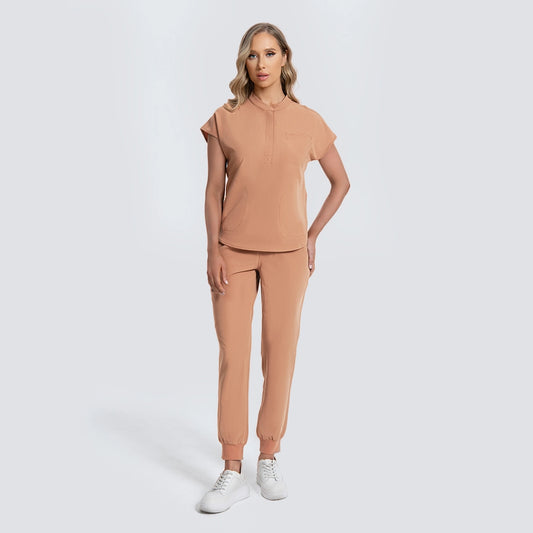
You notice the wrong scrub pant length in small, irritating moments.
The hem catches under your heel while you are walking down the hall. A jogger cuff that looked fine when you got dressed creeps halfway up your calf when you sit. You pull your waistband higher to keep straight-leg pants off the floor, then spend the rest of the shift pulling it back down. By hour eight, the pants are no longer just a fit problem. They are one more thing asking for your attention.
The right length feels different. The waistband stays where it belongs. The hem clears the floor. The knee bends where your knee actually bends. When you sit, squat, reach and walk, the pants move with you instead of making you adjust them.
Finding that length usually comes down to three options: petite, regular or tall. But those labels are only starting points. Your height matters, yet so do your leg proportions, rise preference, work shoes and the cut of the pant itself.
This guide explains how to measure your inseam, how each scrub pant style should land and how to choose the right length before you order.
The Short Answer
Choose your scrub pant length by comparing your measured inseam with the measurements listed for the specific product.
As a general starting point:
-
Petite or short lengths are designed with a shorter inseam and adjusted proportions.
-
Regular lengths fit the middle range offered by the brand.
-
Tall lengths add length through the leg for people whose regular pants consistently finish too high.
Do not choose by height alone. Two people of the same height can have different inseams. One may need petite pants because of a longer torso and shorter legs, while the other may need regular or even tall because more of their height comes from their legs.
The size chart is more useful than the label. Measure first, then check the exact product details.
Why Scrub Pant Length Matters During a Shift
Scrub pants are workwear. Their length affects more than how the outfit looks in a mirror.
A Hem That Is Too Long Can Get in the Way
An open hem that reaches the floor may collect dirt, moisture and debris. It can also slide underneath the heel or catch on the shoe.
If you keep pulling the waistband upward to shorten the leg, the rise and knee placement stop fitting as intended. The hem may clear the floor, but the rest of the pants will no longer sit where they should.
A Leg That Is Too Short Can Affect the Silhouette
Straight-leg pants that finish well above the shoe may look unintentionally cropped. Flare pants lose their intended shape if the widest part ends too high.
Joggers that are too short can hold the cuff above the ankle and create tension through the knee when you sit.
Length Changes How the Knee Moves
Pant patterns are shaped around the body, even when the cut looks simple.
If the leg is too short or too long, the knee area may not line up with your natural bend point. That can create pulling, bunching or extra fabric exactly where you do not want it.
Correct Proportions Create a More Polished Appearance
The same scrub top can look completely different depending on where the pant hem lands.
Correct length creates a clean line from waist to shoe and helps the uniform look intentional throughout the day.
When scrub pants fit correctly, you stop thinking about them. That is the goal.
What Does Inseam Mean?
The inseam is the measurement along the inside of the leg, starting at the crotch seam and ending at the bottom of the pant leg.
It is not the same as your total leg length. It also does not include the rise—the distance from the crotch seam to the waistband.
When a product page lists a 28-inch, 31-inch or 34-inch inseam, it is describing the inside length of the garment.
That number helps predict where the hem or cuff will land, but the final result also depends on:
-
The rise
-
The fabric
-
The leg shape
-
The waistband position
-
Your work shoes
-
How the pants are designed to finish
Your inseam is one of the most useful measurements you can know when shopping online because it is more precise than general descriptions such as “short” or “long.”

How to Measure Your Inseam Correctly
You can measure your inseam in two ways. The easiest method uses pants that already fit well. The second measures your body directly.
Method 1: Measure a Pair of Pants You Already Own
Choose scrub pants or work pants that land correctly with your usual shoes.
-
Wash and dry the pants according to their normal care instructions.
-
Lay them flat on a firm surface.
-
Smooth the leg without stretching the fabric.
-
Lift the upper leg out of the way so you can see the full inside seam.
-
Place the end of a flexible measuring tape at the crotch seam.
-
Follow the inside seam down to the bottom of the hem or cuff.
-
Record the measurement.
If you are measuring straight-leg pants to buy joggers, or measuring joggers to buy flare pants, treat the number as a reference rather than an exact match.
Different silhouettes are designed to finish in different places.
Method 2: Measure Your Body
This method is easier with another person.
-
Put on the work shoes you wear most often.
-
Stand naturally with your feet about hip-width apart.
-
Keep the measuring tape straight without pulling it tight.
-
Measure from the upper inner thigh near the crotch down to the point where you want the pants to finish.
-
Measure both legs if you suspect there may be a difference.
For open-hem pants, measure toward the top of the shoe or the point where you want the hem to break.
For joggers, measure toward the ankle where you want the cuff to sit.
Do not look down or bend while someone measures you. That changes your posture and can shorten the result.
Measure More Than Once
Repeat the measurement two or three times.
If the numbers differ, check whether the tape began at the same point and remained straight.
A half-inch difference may not matter in a flexible jogger, but it can change how a straight or flare leg meets the shoe.
Petite Scrub Pants: More Than a Shorter Hem
Petite scrub pants are intended for people who need shorter vertical proportions.
Depending on the brand and style, that may include:
-
A shorter inseam
-
A shorter rise
-
Adjusted knee placement
-
Higher cargo-pocket placement
-
Shorter overall proportions
That distinction matters. Simply cutting several inches off the bottom of regular pants does not move the knee placement or cargo pockets.
A true petite version is more likely to keep the entire garment in proportion.
Petite May Be Right for You If:
-
Regular hems repeatedly drag on the floor.
-
You have to pull the waistband unusually high to get the right length.
-
The knee area bunches below your natural knee.
-
Cargo pockets sit too low on your thigh.
-
You routinely pay to have new scrub pants hemmed.
-
Regular joggers create heavy bunching above the cuff.
-
The rise feels longer than it should.
-
Straight-leg pants gather heavily around your shoes.
Height can provide a clue, but it should not make the decision by itself.
Someone with a short inseam may need petite pants even if they do not usually shop in a petite clothing department.
Signs Petite Pants Are Too Short
Petite is not automatically better because it keeps fabric off the floor.
The length may be too short if:
-
Straight-leg hems expose much more ankle than intended.
-
The pants pull upward noticeably when you sit.
-
A jogger cuff rests on the widest part of the calf.
-
Flare pants finish before reaching the shoe.
-
The rise feels as though it is being pulled downward during movement.
-
The waistband shifts when you take a long step.
-
The knee area sits higher than your natural knee.
If petite fixes the hem but creates pulling elsewhere, try regular in a shorter-cut style or choose a different silhouette.
Regular Scrub Pants: The Starting Point, Not the Default Answer
Regular is the middle length in most scrub collections.
It is often presented as the standard option, but “standard” does not mean it fits every average-height person.
Regular length may be right when:
-
The open hem clears the floor in your work shoes.
-
The knee area aligns naturally.
-
You can sit without the hem climbing too high.
-
Cargo pockets land at a useful point on the thigh.
-
Jogger cuffs sit at or near the ankle.
-
The waistband stays at your preferred rise.
-
The pants do not require rolling or folding.
-
The hem maintains its intended shape while walking.
If you are ordering a new brand for the first time, regular can be a reasonable starting point only after comparing its listed inseam with a pair you already own.
One brand’s regular may be close to another brand’s tall or petite.
Even within the same brand, joggers and straight-leg styles may use different inseams because they are supposed to finish differently.
Tall Scrub Pants: Length Where You Actually Need It
Tall scrub pants add length through the leg so the garment reaches its intended point without forcing the waistband lower.
Tall may be right for you if:
-
Regular straight-leg pants consistently finish above your shoes.
-
The hem looks correct while standing but rides too high when sitting.
-
The knee shape lands above your natural knee.
-
Cargo pockets sit higher than expected.
-
Jogger cuffs pull above your ankles or onto your calves.
-
Flare pants lose their full shape because they end too soon.
-
You regularly size up just to get more length.
-
The waistband feels pulled downward when you bend or sit.
Tall sizing can benefit people who are tall overall and people with long legs relative to their torso.
Signs Tall Pants Are Too Long
Extra length is not helpful if it has nowhere to go.
Tall may be too long when:
-
An open hem touches the floor.
-
The hem disappears underneath the shoe.
-
Fabric stacks heavily around the ankle.
-
The knee area folds because it sits below your knee.
-
Cargo pockets hang too low.
-
A jogger creates excessive bunching above the cuff.
-
You keep pulling the waistband higher to manage the length.
-
The pant leg twists or collapses around your footwear.
If you are between regular and tall, the right answer depends on the style.
An open hem may be tailored, while a jogger cuff is more complicated to alter without changing the design.

Petite, Regular and Tall Are Not Universal Measurements
This is one of the most important points when buying scrub pants online: length names are not standardized across every product.
A size chart may show an approximate range for petite, regular and tall, but the exact inseam can change with:
-
Women’s, men’s or unisex construction
-
Straight, tapered, jogger or flare legs
-
Mid-rise, high-rise or low-rise patterns
-
Intended break at the shoe
-
Cuffed versus open hems
-
Fabric stretch and recovery
-
Collection-specific design choices
Always open the sizing or product-details section for the exact pants.
Do not assume that every tall pant from a brand has the same inseam, or that the petite jogger matches the petite straight leg.
For example, a brand’s women’s straight-leg styles may use measurements around 28½ inches for petite, 31 inches for regular and 34 inches for tall.
A women’s jogger from the same brand may be shorter in every length because the cuff is meant to stop at the ankle rather than fall over the shoe.
This is why checking the specific product matters more than relying on a general label.
How Scrub Pant Style Changes the Right Length
Two scrub pants with different silhouettes should not necessarily have the same inseam.
The right endpoint depends on how the leg was designed.
Straight-Leg Scrub Pants
Straight-leg pants create a clean, consistent line from the thigh toward the hem.
They usually look best when the hem approaches the top of the work shoe with a small, controlled break.
Correct Length Looks Like:
-
The front of the hem lightly meets the shoe.
-
The back remains clear of the floor.
-
The fabric does not stack heavily at the ankle.
-
Sitting exposes slightly more ankle without pulling at the waistband.
-
The pant leg falls in a clean line.
-
The hem does not catch under the heel.
Too Long Looks Like:
-
The hem folds repeatedly over the shoe.
-
The back drags or gets caught under the heel.
-
The leg appears wider because of bunching.
-
The fabric collects around the ankle.
-
You need to pull the waistband higher to walk comfortably.
Too Short Looks Like:
-
The hem floats above the shoe while standing.
-
The pants look unintentionally cropped.
-
Sitting pulls the hem far up the lower leg.
-
The knee area pulls during a long stride.
-
The waistband shifts downward during movement.
Straight-leg pants are among the easiest styles to hem, provided doing so does not interfere with side vents, zippers or special hem details.
Jogger Scrub Pants
Joggers finish with an elastic or knit cuff.
The cuff should sit securely near the ankle without squeezing or climbing onto the calf.
Because the cuff creates a fixed endpoint, jogger inseams are often shorter than open-hem pants.
Comparing their numbers directly can make a correctly designed jogger appear too short on paper.
Correct Length Looks Like:
-
The cuff rests near the ankle bone.
-
There is a small amount of natural ease through the leg.
-
The knee bends without pulling the cuff dramatically upward.
-
The waistband stays in place when you sit.
-
The cuff does not squeeze the ankle.
-
The lower leg looks tapered rather than stretched.
Too Long Looks Like:
-
Fabric stacks in multiple folds above the cuff.
-
The knee shape sits too low.
-
The leg looks baggy rather than intentionally tapered.
-
The cuff becomes hidden underneath excess material.
-
Cargo pockets sit below their useful position.
Too Short Looks Like:
-
The cuff rests on the calf.
-
Sitting creates tension from ankle to knee.
-
The waistband feels pulled downward.
-
The cuff repeatedly rides up and does not return to the ankle.
-
The knee feels restricted during a squat.
-
The pants resemble cropped leggings rather than joggers.
Joggers are sometimes recommended to petite wearers because the cuff prevents dragging, but the cuff does not correct every proportion.
A petite jogger can still fit better by positioning the knee and pockets correctly.
Tapered and Slim-Leg Scrub Pants
Tapered pants narrow toward the ankle but usually finish with an open hem.
They may be slightly more forgiving than a wide straight leg because less fabric meets the shoe.
The hem should land cleanly without gathering into tight folds.
If the opening is narrow, check whether it catches on the upper part of your shoe. Pants can have the correct inseam but still sit too high if the hem cannot fall freely over bulky footwear.
When trying tapered pants, wear the shoes you use during actual shifts.
A sleek shoe and a heavily cushioned sneaker can change the same hemline noticeably.
Correct Tapered-Pant Length Looks Like:
-
The hem reaches the ankle or top of the shoe.
-
The leg narrows smoothly.
-
There is no heavy stacking at the hem.
-
The opening does not catch on the shoe.
-
Sitting does not pull the pants far above the ankle.
Flare and Bootcut Scrub Pants
Flare pants need enough length for the shape to open and fall correctly.
When they are too short, the flare begins but ends before it can balance over the shoe. When they are too long, the wider hem is especially likely to reach the floor.
Correct Length Looks Like:
-
The hem covers part of the shoe without hiding the entire foot.
-
The back remains off the floor.
-
The flare falls smoothly rather than folding into itself.
-
The silhouette remains balanced when walking.
-
The widest part of the leg opening reaches the intended point.
-
The hem does not swing underneath the shoe.
Choose your work shoes first, then evaluate the flare length.
If you alternate between shoes with very different sole heights, the same pair of pants may not work equally well with both.
Cargo Scrub Pants
Cargo describes the pocket construction rather than the leg shape.
Cargo pants may be straight, tapered or jogger-style, so use the guidance for the underlying silhouette.
Length matters especially with cargo pants because pocket placement is part of the fit.
If regular-length cargo pants are much too long and you simply pull them higher, the cargo pocket may no longer sit where your hand naturally reaches.
If you shorten them significantly at the hem, the knee and pocket positions still remain based on the original pattern.
When the length difference is more than a simple hem adjustment, choosing a true petite or tall construction usually produces better overall proportions.
Check Cargo-Pocket Placement
A well-positioned cargo pocket should:
-
Sit on the thigh rather than directly on the knee.
-
Remain easy to reach while standing.
-
Avoid pressing into the knee while sitting.
-
Stay balanced when carrying lightweight items.
-
Move with the pant leg rather than swinging below it.
How Your Work Shoes Affect Pant Length
The right scrub pant length is connected to the shoes underneath it.
A thick, cushioned sneaker may lift the hem and create more surface for a tapered opening to catch on.
A low-profile slip-on lets the same pants fall lower. Clogs can change where a straight or flare hem breaks across the foot.
Use the following rule:
Measure and try on scrub pants with the shoes you actually wear to work.
If you regularly alternate between two pairs, test both.
The ideal hem should clear the floor with the lower shoe and still reach the intended point with the higher one.
Do not choose a dangerously long hem just because it looks better with one thick-soled shoe. Workwear has to remain practical throughout the shift.
Rise and Waistband Position Can Change the Length
Inseam is not the only vertical measurement that matters.
High-rise pants sit closer to the natural waist. Mid-rise pants sit lower, while low-rise pants sit lower again.
If you wear pants higher or lower than they were designed to sit, the hem position changes and the crotch fit may become uncomfortable.
A drawstring waistband also lets some wearers adjust placement more than a structured waistband.
That can be helpful, but it should not become a permanent strategy for correcting several inches of excess or missing length.
When testing fit:
-
Position the waistband where the design intends.
-
Secure it comfortably.
-
Check the crotch and hip fit.
-
Walk, sit and squat.
-
Only then evaluate the hem.
If you have to move the waistband to an unnatural position to make the length work, choose another inseam.
What to Do If You Are Between Lengths
Being between petite and regular or between regular and tall is common.
The best solution depends on the pant style.
For Straight-Leg Pants
The longer option may be easier to tailor.
Check for vents, trim, zippers or special details before assuming hemming will be simple.
If the waist, hip, rise, knee and pocket placement all fit properly, shortening the open hem may be a practical solution.
For Flare Pants
Choose carefully.
Shortening a flare changes the width of the final opening and may alter the intended proportion.
A professional tailor can preserve the silhouette better than a quick fold or basic home alteration.
For Joggers
Prioritize where the cuff sits and how the knee moves.
Altering a cuffed hem is more involved, so choosing the correct manufactured length is preferable.
If one jogger length is too short and the next is excessively long, another jogger style may have better proportions for your body.
For Tapered Pants
Check how the pants interact with your shoes.
Sometimes the longer option is correct but catches on the shoe, making it appear too short. A different shoe or leg opening can solve the problem.
Consider Your Preference
Some people prefer a little more ankle exposure. Others want full coverage.
Personal preference is valid as long as:
-
The hem remains safely off the floor.
-
The garment moves correctly.
-
The waistband stays secure.
-
The length complies with workplace requirements.
-
The pants remain comfortable while sitting and bending.
The Five-Minute Fit Test
Once your scrub pants arrive, do not remove the tags immediately.
Put on the clean garments carefully and perform this quick check according to the retailer’s return policy.
1. Stand Naturally
Do not pull the waistband higher or lower to influence the hem.
Check where the pants land in your work shoes and whether the knee and pockets align correctly.
2. Walk Quickly
Walk across the room several times.
Make sure the hem does not slip underneath your heel and a jogger cuff does not climb toward the calf.
3. Sit in a Chair
Notice how far the hem rises and whether the waistband pulls downward.
A small amount of movement is normal. Significant pulling may indicate insufficient length or room through the thigh.
4. Squat Comfortably
The knees and crotch should move without sharp tension.
Jogger cuffs should remain near the ankle, and open hems should remain controlled.
5. Step Onto a Low, Stable Surface
This simulates stairs and a longer stride.
Check whether the fabric pulls from ankle to hip or forces the waistband downward.
6. Reach Toward the Floor
An open hem should stay controlled, and the waistband should remain secure.
The pants should provide enough coverage without requiring adjustment.
7. Check Pocket Placement
Cargo and patch pockets should sit where they are easy to reach, not directly on the knee or too close to the hip crease.
If the pants pass this test without repeated adjustment, you are close to the right length.
How to Read a Scrub Pant Product Page
Before adding a pair to your cart, look for more than the size selector.
Check:
-
The exact inseam for petite, regular and tall
-
Whether the measurement changes by size
-
The rise
-
The leg shape
-
The leg opening
-
Whether the hem is cuffed, vented or adjustable
-
The model’s height and length worn, if provided
-
The fabric composition and stretch
-
Reviews from people who mention their own inseam
-
Return or exchange conditions
Model photos are useful for understanding the silhouette, but they are not a measuring tool.
Camera angle, pose, model proportions and footwear can all change how the length appears.
The numerical garment details should guide the final decision.
Can Scrub Pants Be Hemmed?
Many scrub pants can be hemmed, especially simple straight-leg styles.
Hemming may be a good option when:
-
The waist, hip, rise and knee fit correctly.
-
The pants are only slightly too long.
-
The hem has no complicated cuff, zipper or adjustment.
-
A petite option is unavailable.
-
The pocket placement already feels correct.
-
The fabric can be altered without damaging its shape.
Hemming may be less suitable when:
-
The cargo pockets or knee shaping sit too low.
-
Several inches need to be removed.
-
The pants have a jogger cuff.
-
The flare shape would change significantly.
-
The hem contains side vents or elastic.
-
The bottom includes zippers or adjustable cords.
A tailor can tell you whether the original silhouette can be preserved.
Remember that pants can usually be shortened, but they cannot be meaningfully lengthened unless the original hem includes enough extra fabric.
Petite, Regular or Tall: A Final Decision Guide
Choose petite when regular pants are consistently too long through the leg, the knee and pockets sit too low, or you need shorter overall proportions.
Choose regular when the garment’s listed inseam matches your measurement, the knee aligns and the hem or cuff reaches its intended point in your work shoes.
Choose tall when regular pants finish too high, pull upward while sitting or place the knee and pockets above their useful positions.
Then confirm your answer against the silhouette:
-
Straight leg: A clean, slight break over the shoe
-
Jogger: Cuff near the ankle with minimal bunching
-
Tapered: Clean ankle line without catching on the shoe
-
Flare: Enough length to fall over the shoe while staying off the floor
-
Cargo: Correct underlying leg length with useful pocket placement
The label is not the goal. A balanced, safe and comfortable fit is.
The Bottom Line
The right scrub pant length should support your shift quietly.
It should not drag behind you, climb your calf, force the waistband into the wrong position or make you rethink every pair of shoes.
It should let you walk quickly, sit comfortably and bend without pulling the rest of the garment out of place.
Measure the inseam of pants you already trust. Wear your real work shoes. Read the product-specific measurements. Consider how the pants are designed to finish.
Then test the entire fit in motion—not just the hem in a mirror.
Petite, regular and tall are useful labels, but your measurement is the better answer.
At KungFu Scrubs, we believe workwear should move with purpose. Find the length and silhouette that let you focus on the work ahead, from the first round to the final handoff.
Frequently Asked Questions
How Do I Know Whether I Need Petite, Regular or Tall Scrub Pants?
Measure the inseam of pants that fit well and compare it with the exact product measurements.
Also check where the knee, pockets and waistband sit. Height ranges are only general starting points.
What Is the Difference Between Petite and Short Scrub Pants?
Brands may use the terms differently.
Some short options primarily reduce the inseam, while petite construction may adjust other vertical proportions such as the rise, knee and pocket placement.
Read the product description and size chart to confirm.
Does Petite Sizing Mean a Smaller Waist?
Not necessarily.
Length and overall size are separate choices. A brand may offer the same waist or hip size in petite, regular and tall lengths.
Should Scrub Pants Touch the Floor?
No.
Open hems should remain clear of the floor while you stand and walk in your usual work shoes.
Where Should Straight-Leg Scrub Pants End?
They generally look and function best when the front lightly meets the top of the shoe and the back remains off the floor without heavy bunching.
Where Should Jogger Scrub Pants End?
The cuff should sit near the ankle.
It should not squeeze the calf, pull sharply when you sit or create excessive fabric stacking above it.
Why Are Jogger Inseams Shorter Than Straight-Leg Inseams?
Joggers are designed to stop at the ankle, while straight-leg pants often extend over the top of the shoe.
Their inseam measurements should not always match.
What Should I Do If Petite Is Too Short but Regular Is Too Long?
For a simple straight-leg style, consider buying the longer option and having it professionally hemmed.
For joggers and flares, compare other styles because alterations can change the intended silhouette.
Can Tall Scrub Pants Be Hemmed?
Yes. Many open-hem styles can be shortened.
However, major alterations will not correct knee or pocket placement, and cuffed or flared styles may require more specialized tailoring.
Do I Measure My Inseam With Shoes On?
For a body measurement, wear the shoes you use at work so you can identify the correct endpoint.
When measuring an existing garment, measure the inside seam from the crotch to the hem and then test the pants with your shoes.
Can Washing Change Scrub Pant Length?
Fabric behavior varies.
Follow the care label and test one pair through your normal washing routine before buying several identical pairs.
Is Height Enough to Choose Scrub Pant Length?
No.
Height can narrow the options, but your leg-to-torso proportion, inseam, rise, footwear and pant style provide a more accurate answer.
Should I Size Up to Get More Length?
Usually not.
A larger size changes the waist, hip and overall fit but may not add the inseam you need.
Choose the correct size first, then select the appropriate length.
Why Do My Scrub Pants Fit While Standing but Feel Short When Sitting?
Sitting bends the hip and knee, drawing fabric upward.
If the hem rises excessively or the waistband pulls down, you may need more length, more room through the thigh or a different rise.
Are Petite Joggers a Good Choice If I Usually Step on Scrub Hems?
They can be.
The cuff keeps fabric away from the floor, and petite construction may improve the knee and pocket placement.
Confirm that the cuff still reaches your ankle without pulling.