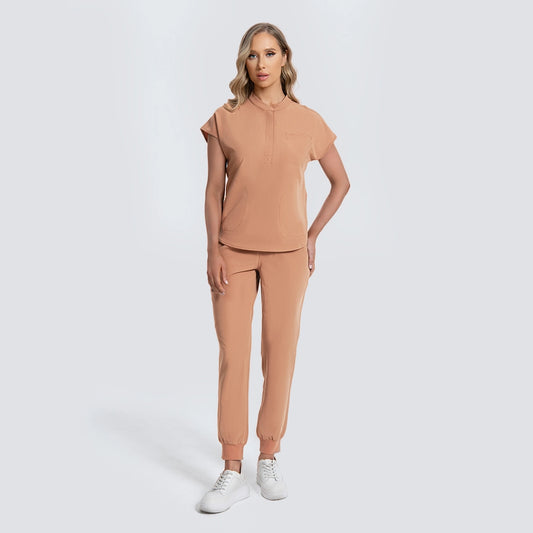
Walk into an NHS hospital in England in 2026 and you may notice staff wearing a much broader — yet more coordinated — range of colours. Hospital blue, navy, lilac, bottle green, teal, ruby and white are becoming part of a new visual system designed to help patients identify different healthcare professionals.
However, the change is not happening everywhere at once. The NHS Healthcare Uniform is a national framework for England, but adoption is led by individual NHS trusts. Some organisations have already introduced the new uniforms, while others are still using their existing local designs or moving through a gradual transition.
So, what do the new NHS uniform colours mean, who will wear them, and why might old and new uniforms still appear on the same ward?
Why is the NHS introducing new uniform colours?
Historically, NHS trusts in England selected their own uniform styles, colours, trims and rank markings. This created enormous variation between hospitals.
A navy scrubs uniform might identify a senior nurse in one trust but mean something different in another. Healthcare assistants could wear lilac, green or blue depending on the organisation. Staff transferring between trusts often had to learn a completely new colour system, while patients could not reliably identify a person’s profession by looking at their uniform.
NHS Supply Chain says that more than 30,000 uniform variations have been used across the system. The NHS in England also spends approximately £23 million on uniforms every year, with substantial differences in the price paid for similar garments.
The new framework aims to simplify this situation by standardising garment designs, materials and colourways. A larger national purchasing system could reduce costs by an estimated 30% to 50%. If every trust adopted the framework, the projected saving could reach approximately £10 million over three years.
The reform is also intended to improve the patient experience. Colour provides an initial clue about a member of staff’s professional group, while their name badge confirms their exact role.
What do the new NHS uniform colours mean?

The framework primarily assigns colours by profession and clinical role, rather than simply matching darker colours with higher Agenda for Change pay bands.
The most common colourways include:
| Main uniform colour | Typical role or professional group | Common trim |
|---|---|---|
| Cloud blue | Learners and students | Navy |
| Sky blue | Nursing Associates | Navy |
| Hospital blue | Registered Nurses | Navy |
| Postman blue | Registered Midwives | Navy |
| Navy | Team Leaders and some advanced nursing roles | Dark red |
| Lilac | Healthcare Assistants and Support Workers | Navy |
| Purple | Matrons and senior nursing management roles | Trust dependent |
| Bottle green | Pharmacists | Navy |
| Sherwood green | Pharmacy Technicians | Navy |
| Eau-de-nil or peacock | Healthcare Science roles | Contrasting trim |
| White or ruby | Allied Health Professionals | Profession-specific trim |
| Black | Heads of Department | Dark red |
These assignments describe the national framework, but individual trusts remain responsible for mapping their local job titles to the available colourways.
Blue Scrubs uniforms: nursing and midwifery
Several shades of blue are used across nursing and midwifery.
Cloud blue generally identifies learners or students. Sky blue is associated with Nursing Associates, while hospital blue is used for Registered Nurses. Registered Midwives commonly wear postman blue.
Navy is usually reserved for Team Leaders and certain senior or advanced nursing roles, often with dark-red trim. However, uniform colour is not a direct substitute for an Agenda for Change band. Two employees on the same pay band can wear different colours because they hold different professional roles.
During local implementation, some trusts may also make adjustments following staff consultation. Patients should therefore treat the colour as a helpful guide and confirm the person’s role by checking their identification badge.
Lilac and purple uniforms: support and leadership
Under the national framework, Healthcare Assistants and Support Workers generally wear lilac with navy trim.
This gives nursing support staff a recognisable identity that is distinct from the hospital blue worn by Registered Nurses. It may help patients understand who is providing day-to-day support and who holds registered clinical responsibilities.
Purple is commonly associated with Matrons or other senior nursing management roles. Exact local assignments can vary, so purple should not be interpreted as one specific job title in every hospital.
Green Scrubs uniforms: pharmacy teams
The pharmacy profession uses a green colour family.
Pharmacists generally wear bottle green, while Pharmacy Technicians are associated with Sherwood green. The distinction separates pharmacy teams visually from the blue nursing and midwifery group.
For patients, this can make it easier to identify staff who may be able to help with medicines, prescriptions, doses and potential drug interactions.
Teal uniforms: healthcare science
Eau-de-nil and peacock-style teal colours are used for Healthcare Science roles.
Healthcare Science covers a wide range of laboratory, diagnostic, physiological and technical professions. Because this workforce is diverse, the main colour may be combined with contrasting trim and a clearly labelled identification badge.
Colour alone will not always explain a healthcare scientist’s exact speciality. Patients should check the person’s badge or ask them to introduce their role.
White and ruby uniforms: Allied Health Professionals
Allied Health Professionals, usually referred to as AHPs, may wear white or ruby garments with profession-specific coloured trim.
This group includes physiotherapists, occupational therapists, speech and language therapists, podiatrists, orthoptists, diagnostic radiographers, therapeutic radiographers and several creative therapy professions.
Because multiple professions can share the same main garment colour, the trim becomes especially important. From a distance, however, a narrow line of colour may be difficult to see. A name badge remains the most reliable source of information.
Are doctors included in the new uniform framework?
Doctors are not the primary focus of the NHS Healthcare Uniform framework. Its main scope covers nursing, midwifery, pharmacy, Healthcare Science and Allied Health Professions.
Paramedics and ambulance personnel should not automatically be placed within the same colour system either. NHS Supply Chain operates a separate National Ambulance Uniforms framework for ambulance-related roles.
This means that not every clinical worker seen inside an NHS building will follow the same colour chart.
Is the uniform system mandatory across the UK?
No. This is one of the most important facts about the new uniform colours.
The NHS Healthcare Uniform discussed here applies to England. Scotland and Wales operate their own national uniform systems, with different colours and role assignments. The English colour chart should not be applied to hospitals in Scotland, Wales or Northern Ireland.
Even within England, adoption is not compulsory. NHS Supply Chain states that implementation is a trust-led decision. Each trust can join the framework when it reaches an appropriate point in its existing uniform replacement cycle.
Hospitals that have not adopted the framework can continue to use their local uniform policies. As a result, the same colour may still mean different things at different English hospitals in 2026.
Why are old and new uniforms being worn together?
Changing a uniform system is more complicated than collecting the old garments and handing out new ones.
A trust must map hundreds of local job titles to the national colourways, calculate size requirements, order stock, organise fittings, communicate the change to patients and arrange exchanges for unsuitable garments. It must also consider new starters, pregnant employees, staff with disabilities and people who require culturally appropriate clothing options.
Some organisations have paused or adjusted parts of their rollout after receiving feedback about fabric, fit or colour choices. Others are introducing the uniforms one department at a time.
It is therefore normal for old and new uniforms to appear together during the transition. One member of staff may already have received the new design, while a colleague is still waiting for the correct size or continuing to wear an approved older uniform.
What else has changed besides the colours?
The new garments use a smart scrub-style design. They are intended to offer the practical movement of scrubs while maintaining a structured and professional appearance.
The framework includes tops, trousers and dresses in the available colourways. According to NHS Supply Chain, the fabric combines recycled polyester with cotton sourced through the Better Cotton Initiative. It also provides at least 10% mechanical stretch.
The design priorities include:
- Freedom of movement during clinical work
- A lighter and cooler feel than some traditional tunics
- Easy washing and drying
- Little or no ironing
- Durability under NHS laundering requirements
- Inclusive options for different body types and needs
During two phases of wearer trials, 1,000 garment sets were distributed across ten sites. More than 400 staff members provided feedback. NHS Supply Chain reports that 87% felt the garments offered a full range of movement, while 73% said the fabric supported a comfortable temperature.
Real-world experience may still vary, however. Fit, sizing, heat, pregnancy options and fabric sensitivities need to be managed carefully by every participating trust.
Are the new uniforms more sustainable?
Sustainability is one of the stated objectives of the programme.
Standardising thousands of fragmented designs could make manufacturing and procurement more efficient. The use of recycled polyester and responsibly sourced cotton is also intended to reduce the environmental impact of the garments.
Old uniforms should not simply be placed in household rubbish or donated without permission. Clothing carrying NHS branding can create identity and security risks if it enters an uncontrolled resale market.
Where a trust does not already have a suitable arrangement, framework suppliers can provide information about compliant third-party textile recycling. Staff should follow their employer’s official return or disposal instructions.
Will colours really help patients?
A standardised system can make staff easier to identify, particularly for patients who move between community care, outpatient services and acute hospitals. Reducing thousands of local variations creates a more predictable visual language.
However, colour has limitations.
Similar shades of blue or green may be difficult to distinguish at a distance. People with colour-vision deficiencies may not be able to recognise every contrast. AHP professions may be separated only by narrow trim, and old uniforms will remain visible during the transition.
Most importantly, a colour indicates a broad professional group — not everything a person is qualified or authorised to do, and not whether they are responsible for a particular patient that day.
The safest approach is to use three forms of identification: uniform colour, name badge and verbal introduction. Patients should always feel able to ask, “What is your role?” or “Are you the person looking after me today?”
What should NHS employees and new starters do?
Employees should not purchase a uniform based only on a colour chart found online.
New starters should check their trust’s current uniform policy, onboarding information and ordering instructions. They should confirm whether the organisation has adopted the national framework and how their local job title has been mapped.
After receiving a uniform, staff should check:
- Shoulder and arm movement
- Coverage when sitting or bending
- Trouser length and waist fit
- Pocket position and practicality
- Skin comfort and possible sensitivities
- Changes after washing
A garment that restricts movement or creates a safety concern should be exchanged rather than tolerated. Pregnant employees and staff who need disability-related, cultural or religious adjustments should contact their manager or local uniform team.
Will NHS uniforms eventually become completely standardised?
England is clearly moving towards fewer designs and a more consistent national colour system. More trusts are likely to adopt the framework when their existing uniforms need replacement.
Complete uniformity, however, is neither likely nor necessarily desirable. Different professions still need distinct identities, specialist environments require appropriate workwear, and uniforms may not be suitable in some mental health or community settings.
The success of the programme should therefore be judged on more than the appearance of hospital corridors. It must deliver four practical results: easier identification for patients, safe and comfortable clothing for staff, better value for trusts and responsible recycling of old garments.
In 2026, the new NHS uniform colours are best understood as a shared language that is still being introduced — and one that retains some local accents.
Look at the colour, check the name badge and confirm the role. That is the most reliable way to understand who is who in an NHS hospital.